

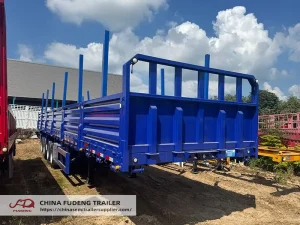
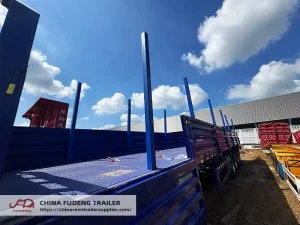


A 4 Axle Fence Cargo Semi Trailer for Sale is a practical choice for transport companies that need to move heavy and bulky goods over long distances. With a four-axle chassis, reinforced cargo platform, and removable side fences, this trailer is suitable for transporting bagged cement, agricultural products, steel materials, timber, and other general cargo.
For transport businesses in Africa, where trailers often operate on a mix of highways, rural roads, and construction routes, durability and easy maintenance are important. Fudeng Group provides customizable fence cargo semi trailers to meet different cargo requirements, road conditions, and local transport regulations.
What Is a 4 Axle Fence Cargo Semi Trailer?
A 4 axle fence cargo semi trailer is a heavy-duty trailer equipped with four axles and a cargo platform surrounded by metal side fences. Unlike a flatbed trailer, the fence structure helps keep loose and packaged goods in place during transportation.
The side fences can be designed according to the type of cargo being transported. This makes the trailer suitable for businesses that handle different goods throughout the year.
Common applications include:
-
Agricultural transport: Grain bags, animal feed, fertilizer, and other farm products.
-
Construction materials: Bagged cement, bricks, steel bars, and building supplies.
-
Industrial cargo: Steel pipes, metal products, and factory materials.
-
Timber transport: Wood, boards, and other long materials.
-
General freight: Palletized goods, packaged products, and commercial cargo.
For companies that need to transport different types of goods with one trailer, the fence cargo design offers greater flexibility.

Fudeng Fence Semi Trailer Side & Rear View

Blue Side Wall Semi Trailer Rear View
Main Specifications of 4 Axle Fence Cargo Semi Trailer
The following specifications are common reference configurations. The final design can be adjusted according to the customer’s cargo, tractor truck, and local regulations.
| Item | Specification |
|---|---|
| Trailer Type | 4 Axle Fence Cargo Semi Trailer |
| Trailer Length | 12,500–13,000 mm |
| Trailer Width | Approx. 2,500 mm |
| Axles | 4 axles |
| Loading Capacity | Approx. 60–80 tons, subject to configuration and local laws |
| Suspension | Mechanical / Air Suspension |
| Tire Size | 12R22.5 or customized |
| Tire Quantity | Commonly 16 tires |
| Main Beam | High-strength steel |
| Brake System | Dual-line air brake |
| Landing Gear | Heavy-duty landing gear |
| Side Fence | Customized height and structure |
| Color | Customized |
| Application | Agricultural products, construction materials, and general cargo |
Actual payload depends on the trailer’s tare weight, axle ratings, tractor specifications, road limits, and applicable regulations. A four-axle design does not automatically mean the trailer can legally carry 80 tons in every market.

Toolbox & Safety Guard

Trailer Tire & Axle
Strong Chassis for Heavy-Duty Transportation
The chassis determines how well a fence cargo trailer handles heavy loads and repeated road impacts. For a four-axle model, the main beam, crossmembers, and suspension mounting points must work together to support the cargo weight.
Fudeng Group can configure the trailer with high-strength steel beams and reinforced structural components according to the required loading conditions. Beam dimensions and steel thickness can be selected based on the intended application rather than using the same design for every customer.
A well-designed chassis helps:
-
Improve resistance to bending under heavy loads.
-
Distribute cargo weight across the trailer structure.
-
Reduce the risk of premature structural fatigue.
-
Support long-term operation under demanding working conditions.
The cargo floor can also be customized with suitable steel plates for bagged products, building materials, and other freight. For customers transporting heavier or abrasive goods, the floor thickness should be selected according to the expected load and loading method.
Fence Structure: More Than Just Side Protection
The main difference between a fence cargo trailer and a flatbed trailer is the side fence structure. It provides additional support for cargo and helps organize goods on the platform.
The fence height, spacing, and construction can be customized for different applications. Lower fences may be suitable for palletized goods and steel products, while higher fences can offer more support for bagged agricultural products and general cargo.
Depending on the transport requirements, customers can choose:
-
Removable or fixed side fences.
-
Different fence heights.
-
Reinforced fence posts.
-
A front headboard to help prevent forward cargo movement.
-
Customized floor structures for specific cargo types.
However, side fences are not a substitute for proper cargo securing. Straps, chains, and other suitable restraints should be used when necessary, especially when transporting heavy or irregularly shaped materials.
Why Choose a 4 Axle Fence Cargo Trailer?
When comparing a four-axle trailer with a three-axle model, the best choice depends on the cargo weight, road regulations, and operating costs.
Higher Potential Load Capacity
Four axles provide additional load distribution capacity when the trailer is properly engineered and the local regulations permit the configuration. This can be useful for businesses transporting dense construction materials or heavy industrial goods.
Better Load Distribution
An additional axle can help distribute weight across more wheel positions. Correct axle spacing and suspension matching are essential for achieving the intended result.
Flexible Cargo Transportation
The open platform and side fences allow the trailer to handle a wide range of packaged and general cargo. Operators can use the same trailer for different transport jobs without needing a fully enclosed body.
Practical Maintenance
A straightforward fence structure is generally easier to inspect and repair than a more complicated enclosed cargo body. Replaceable fence components can also simplify repairs if individual sections are damaged.
For fleet owners, these features can help improve equipment utilization and reduce unnecessary downtime.


Reviews
There are no reviews yet.